
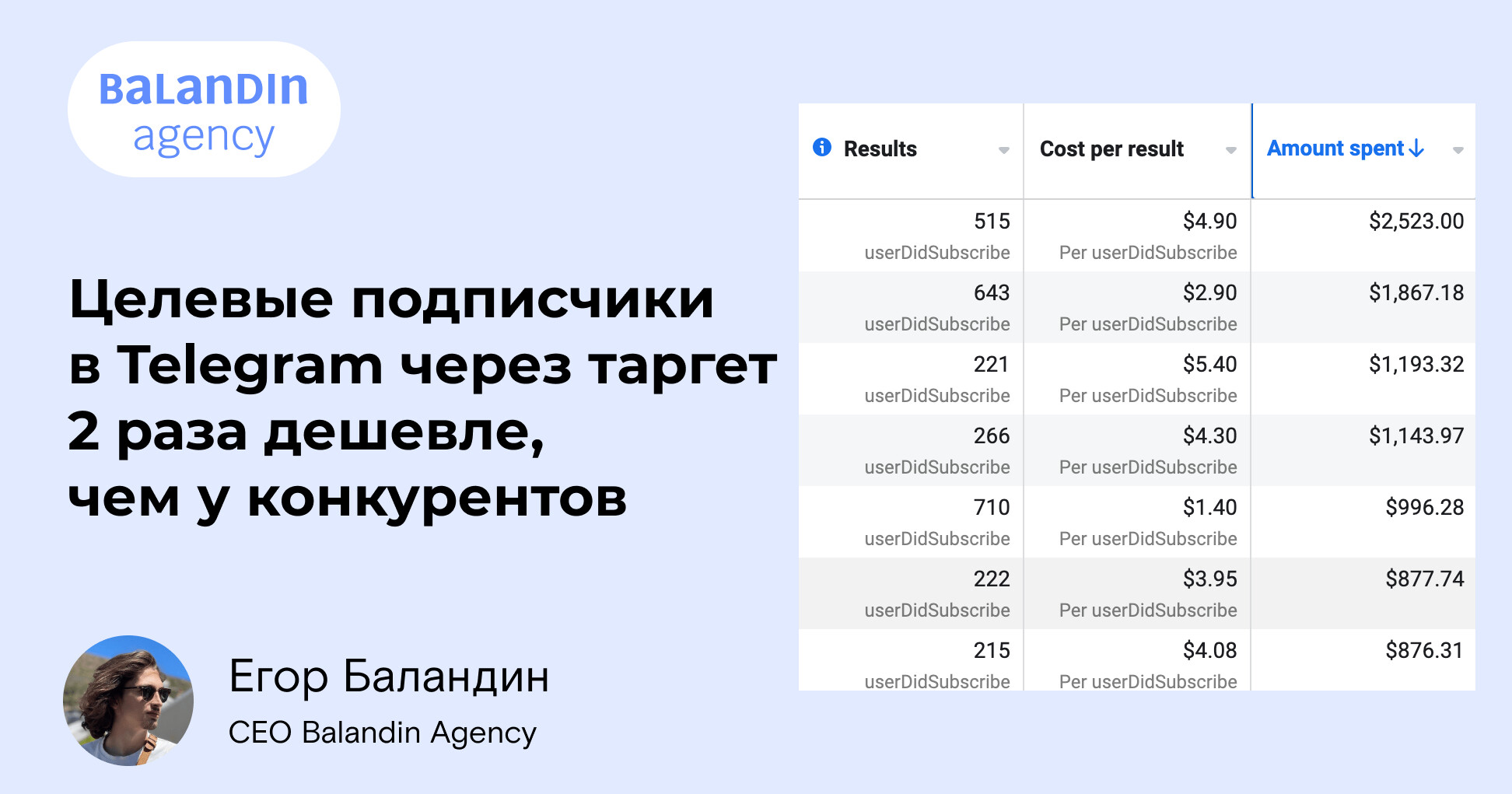
Facebook Ads works really well because of its optimization. But when we run traffic to Telegram, the best we could do was optimize for a click on the button on a pre-lander (a mini-site with a button leading to the Telegram channel).
Even that method can deliver results, but the result can be much better.
In this case I will tell you how we managed to bring 50–100 subscribers a day from Instagram and what it takes.
The task
Our client is an expert in copywriting and building sales funnels.
The task they set us was to drive traffic not into chatbots, but into a Telegram channel, to grow an audience on Telegram and sell through content marketing.
Tools used
As I wrote above, the usual traffic methods are less effective; we needed a solution that could let Facebook optimize for Telegram channel subscription events.
By a happy coincidence, one of the client’s subscribers recommended a service that helped analyze Telegram channels and had similar functionality for Yandex Direct. After talking to their support, the client and I managed to get conversion tracking inside Facebook implemented.
With this service you can track detailed analytics by source for every subscriber and send subscriber data to Facebook. The service is also available as a Telegram bot.
The setup requires some steps, and an average expert or media buyer will not figure it out right away, but their tech support can help with installation.
The promotion approach
Once the technical side was settled, we had to deal with the most important thing — how to promote the Telegram channel.
We concluded that classic messages like “This is my Telegram channel about such-and-such, subscribe” would not deliver. And we moved on to testing lead magnets.
Luckily we had a lot of data on the cost of entering the client’s various funnels, and we decided to start with them.
The ad funnel
The customer path was fairly simple — we made a simple mini-landing page that said which lead magnet the customer would get and called them to go to the Telegram channel via a button.
The user clicks the button and lands on a post in the channel that already contains instructions for receiving the lead magnet.
The service registers the customer’s click and links it, provided they subscribed to the Telegram channel, and based on that sends a server-side event to Facebook.
This was not very convenient, as part of the traffic dropped off. A little later the team at “Subscription source bot” implemented an automatic redirect from the landing page, and that raised conversion significantly, since the path became simpler for the customer: click on the ad → land on a specific post in the Telegram channel.
Ad creatives
Last, but not least, was the question of creatives.
Testing the current approach, we made static creatives with a direct message — “get a lead magnet about this and that”.
During testing we understood some important things about creatives:
- The visual came second; the most important thing is the message we offer
- We had a hypothesis that we needed to make it clear to the customer that they would get the lead magnet on Telegram, and say so explicitly with logos, colors, and “Go to Telegram” calls — but testing different approaches we saw that mentioning Telegram does not affect conversion at all
- Simplicity of the offer gives a cheaper subscriber. The simpler and shorter you explain why the user needs this lead magnet, the cheaper the subscriber.
In the first month we got 1,200 subscribers at 220 rubles per subscriber. It was important to the client to get a subscriber under 250 rubles; we hit the KPI, but felt we could do better.
Scaling
Testing different funnels with different lead magnets and creatives, we managed to reach 150–180 ₽ per subscriber at volume, but still ran into some problems — sometimes the price shot up and the results were unstable.
Thinking it over while scrolling reels one evening, I came across amusing, captivating videos that you really want to watch to the end.
And so the idea was born to turn the static creatives into video.
Our main problem was that we either had to film the expert on camera — which the expert did not much want to do — and test a lot to find something that could stick.
Besides that, static creatives did not let us fully convey the essence, since we only had a headline and a subheadline.
And the idea of captivating videos prompted us to test making creatives in a different format.
This method turned out to be fairly simple to implement:
-
Write out a detailed offer in text — what we offer — add a “hook” at the beginning and a call to action at the end. This text will be voiced by an AI model. We took the text from the landing pages and adapted it to a conversational tone. 3–4 sentences are enough.
-
Voice this text with ElevenLabs. At first we used the ready-made voices, but for $5 a month you can create your own voice there. And in our case the standard voices work even better than the expert’s voice. We tried to keep the audio no longer than 25 seconds.
-
Search the internet for a captivating video on the lead magnet’s topic. Sometimes we tested a captivating video completely off-topic
-
In a video editing app, overlay the AI-generated voice on the video, create automatic subtitles, show only one word at a time, enlarge the font and place it in the center of the video (so it can be run both in the feed and in Stories/Reels), and add trending music in the background.
This method turned out to be so simple and effective that we now use it on other projects too.
And the results speak for themselves:
After introducing these creatives we were able to bring the cost per subscriber down to 80 ₽.
This case does not reveal the landing pages and creatives. The project is active, and revealing our trump cards would not be fair to the client. But we really wanted to share such a working method with the community.