
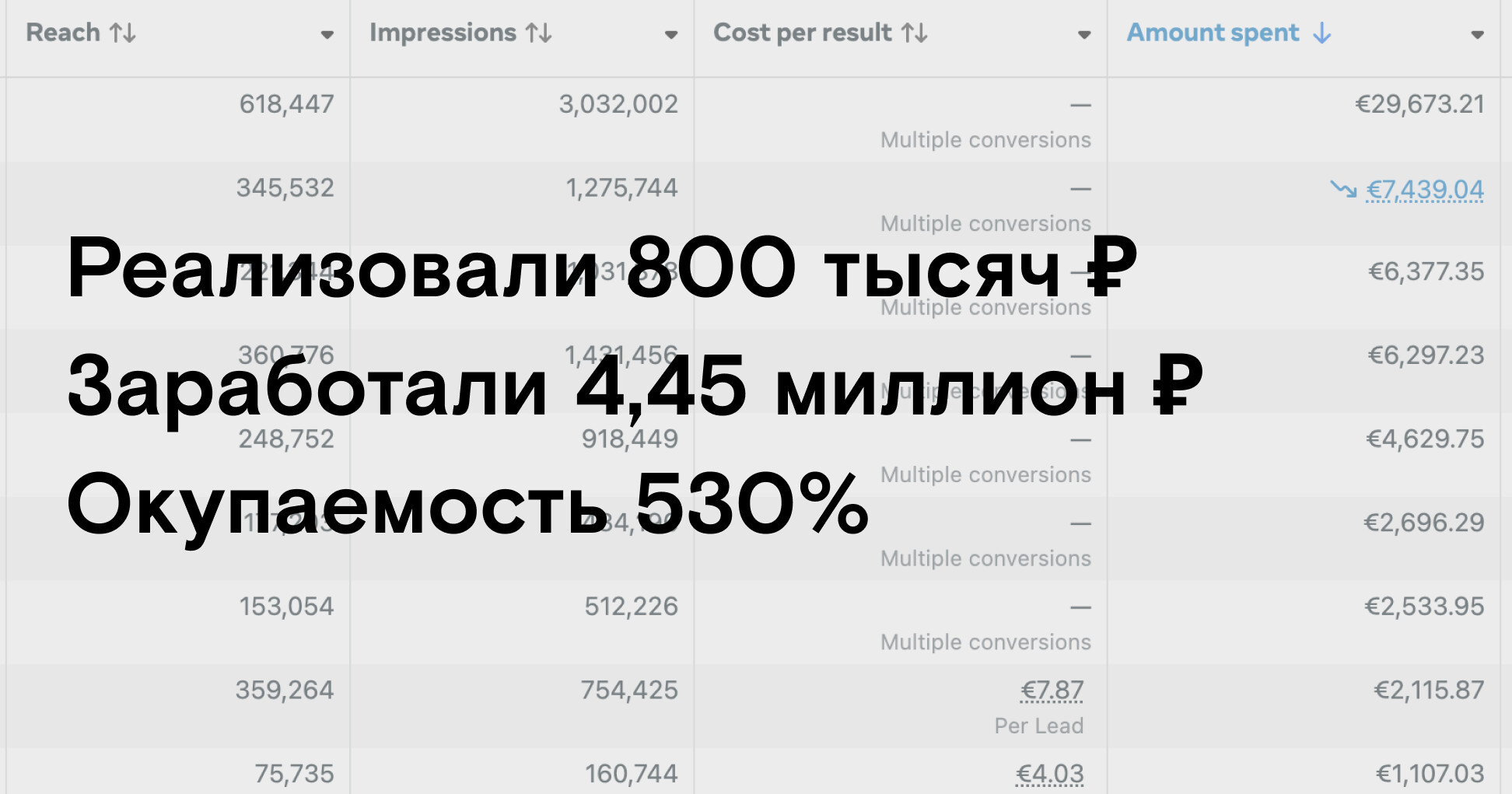
We brought the client 500 qualified leads and paid the ads back 530%, including the cost of our services. Read to the end to learn the 6 non-obvious techniques that help us achieve this.
Who wrote this article
My name is Egor Balandin. I run an agency that brings customers to online schools through paid ads on Facebook, Yandex and Telegram. In 2023 we managed $300,000 of spend at an average 300% ROMI; our clients earned $450,000 from our traffic.
Results
For February and March 2024 we got the following numbers:
Ad budget + agency fee: 835,703.11 ₽
Revenue across all products: 4,450,000 ₽
ROMI: 532%
The task
Client: a consulting project for business owners and their teams on building HR departments worldwide.
We had to build systematic acquisition of qualified leads into the client’s sales funnel through a tripwire product, after which the main product was sold.
What we did
- Built proper analytics
Our client has several sales funnels — acquiring requests for the tripwire, acquiring webinar registrations where the tripwire is sold, and acquiring lead magnet downloads after which the idea of buying the tripwire is sold.
We had to figure out how to correctly evaluate the effectiveness of each funnel, since the target action we drive from ads is always different, and you cannot equate a lead magnet download, a webinar registration and a tripwire request.
So for every funnel we built a report with the following metrics:
-
How many qualified people we acquire. A qualified lead is a person who is an owner and has 10+ employees reporting to them.
-
How many people leave a request to buy the tripwire after going through each of the sales funnels
-
How many people eventually bought the tripwire
-
How many initial target actions there were (webinar registrations, lead magnet downloads and requests).
This helped us understand right in the first month which funnels currently pay back and which do not.
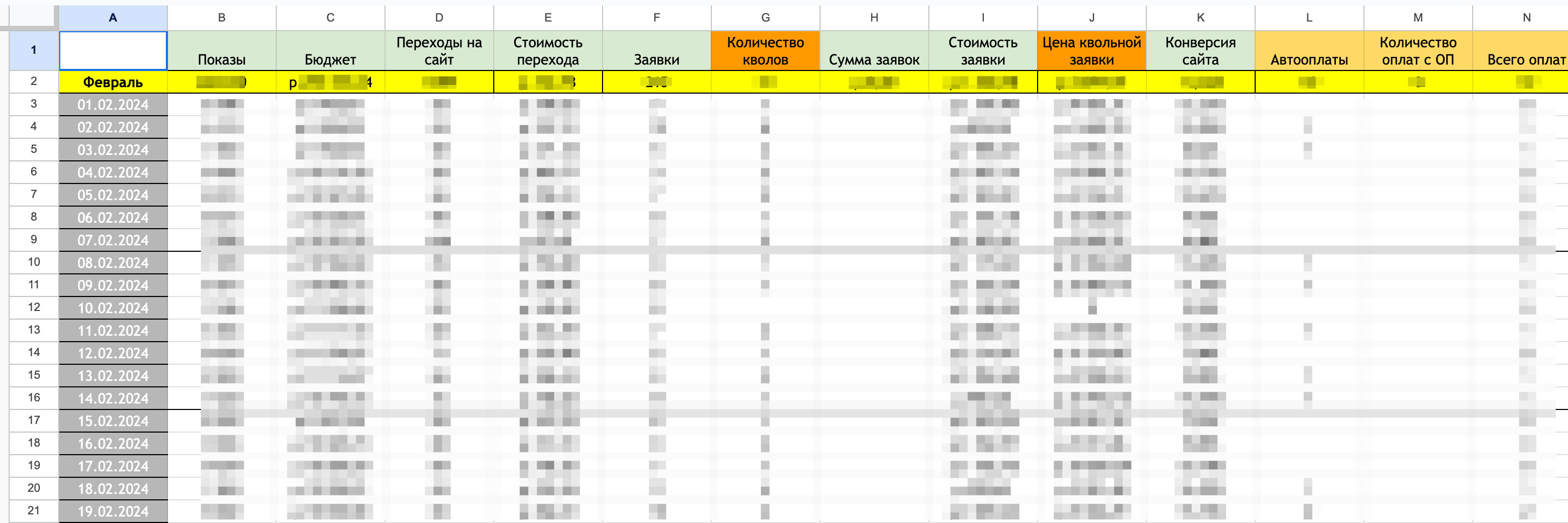
There we realized that the lead magnet funnel, though it looks the most “useless”, brings customers 30% cheaper than the webinar funnel, and we were able to drop direct ads for the webinar, since it did not pass on cost.

- Changed the creative strategy
The second step was to increase the number of qualified leads from the ads. That is mostly influenced by the ad creatives and the messages on them.
Here too we were helped by analytics and a deep dive into the client’s business.
The creatives that existed when we joined the project:

We applied our approach to creatives:
-
Having studied the customer interviews in detail, we made a list of hypotheses on messages and visuals and tested them. That is, we took ideas not out of our heads, but from the conclusions of qualitative research.
-
We analyzed competitors and formed hypotheses on how we could differ and stand out among them.
-
We launched weekly tests of different ad formats: video creatives, static creatives, carousels, slideshows, to find the formats that suit us best.
A few useful tricks for creating creatives:
— When you work with B2B, it is important to quickly convey the end value of your product, so video creatives work best for us. Once that became clear, we set up a process where every 2–3 weeks the client records 5 to 10 video creatives by our brief with different wording and calls to action. We edit them and put them to work.
— Switch off subjective judgments. For example, we tried to make the creatives more “stylish” and youthful, but our audience is 30+, and in the end creatives with simple and slightly “homespun” design worked better. A “focus group” (several acquaintances representing the audience) helped us a lot. They gave feedback on the creatives, which helped us hit the pain points better and understand faster what to do next.
— To test a video creative hypothesis we did not immediately brief the client to record a video; instead we voiced the creative ourselves in the expert’s voice using AI and put it to the test (more in the Telegram channel). That way we did not wait up to 3 weeks, but verified the hypothesis in 2 days.
— We sent the media buyer to watch the webinars, read the lead magnets and go through the paid product. We also attended the client’s internal meetings: sales team stand-ups and presentations of research results. That way the specialist understood the product better and could propose more precise hypotheses.
— We did not waste time on visuals. We made static creatives with simple design; the emphasis was on the messages and meaning in the creative. We quickly found wording that produces qualified leads and sales. Then we scaled that wording to video creatives.
— We paid attention to the main idea. We noticed that one of the lead magnets attracts qualified leads much cheaper than the others. We dug in and realized that one specific topic attracts exactly the leads we need. We shifted the emphasis in the ads and reduced the cost per qualified lead 1.5 times.
Because all the successful creatives are still in use on the project, I cannot show them, as it could affect the effectiveness of these ads.
- Segmented the audience by country
The next step was trying to determine which country the most qualified leads come from.
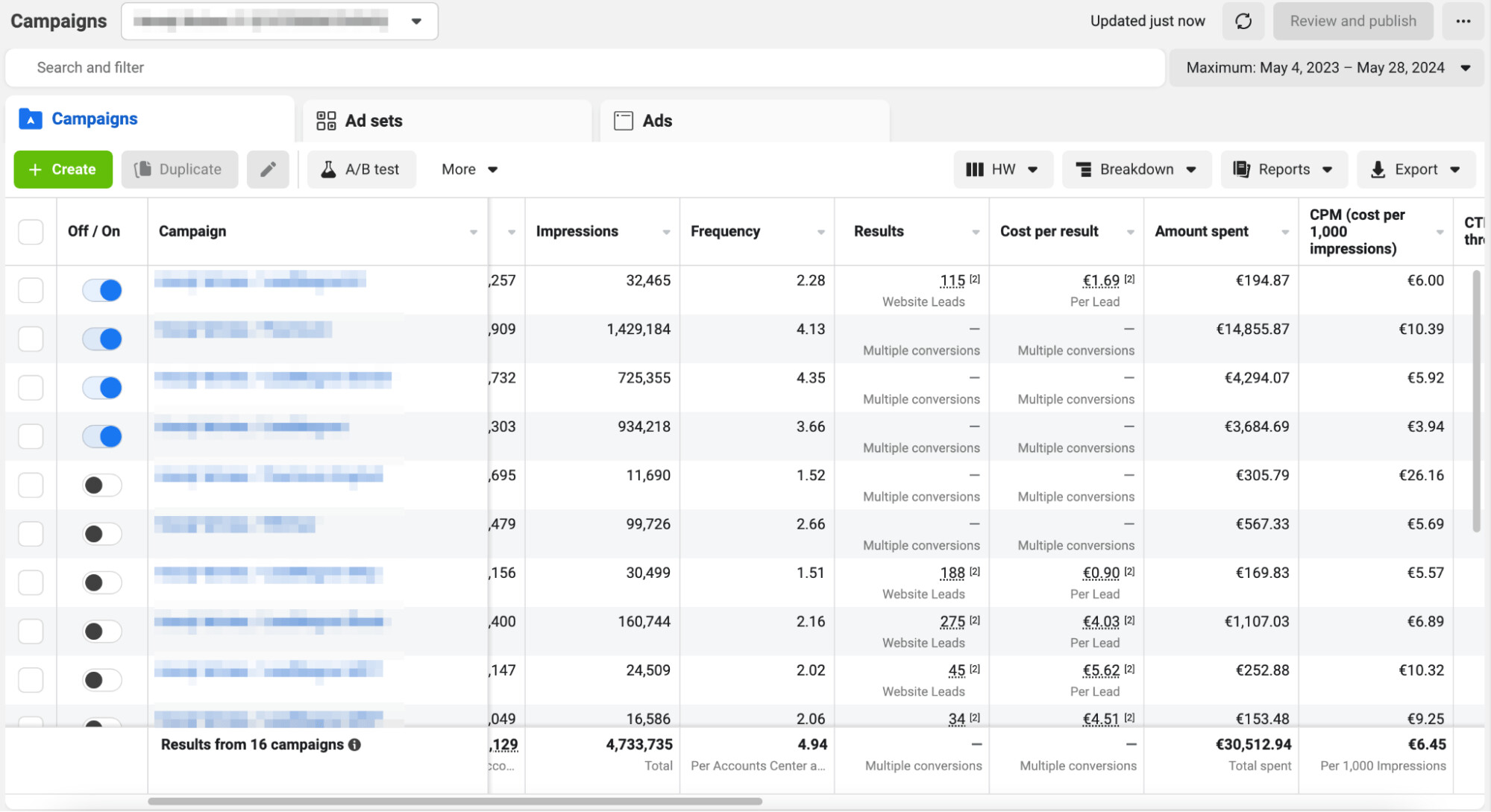
Initially we used a “worldwide ads” strategy excluding non-target regions. This gave us the cheapest cost per impression, but we could not see how leads from each country moved through the sales funnel.
We started splitting the ads by the regions we got the most impressions from. In the first iteration the tests failed — the cost of the final result was simply higher, since the CPM grew.
Then we did a simple personalization: for each target region we created a separate landing page and personalized the creatives. This helped us scale the ad budget by expanding the geography without the cost per lead growing.
- Changed the optimization to target events
To raise the effectiveness of the ads even further, we set ourselves the task of optimizing not just for getting requests, but for getting only qualified leads.
That is, sending Facebook data only about the leads that meet our criteria. This method helped us lower the cost per qualified lead by 15–30% without changing the content, purely through technical settings.
I described how to implement the same method in detail in a separate article.
- Improving the sales funnels together with the client
The ad result depends very heavily on the landing page and the funnel we drive the ads to, so together with the client we constantly work on improving the sales funnel conversions.
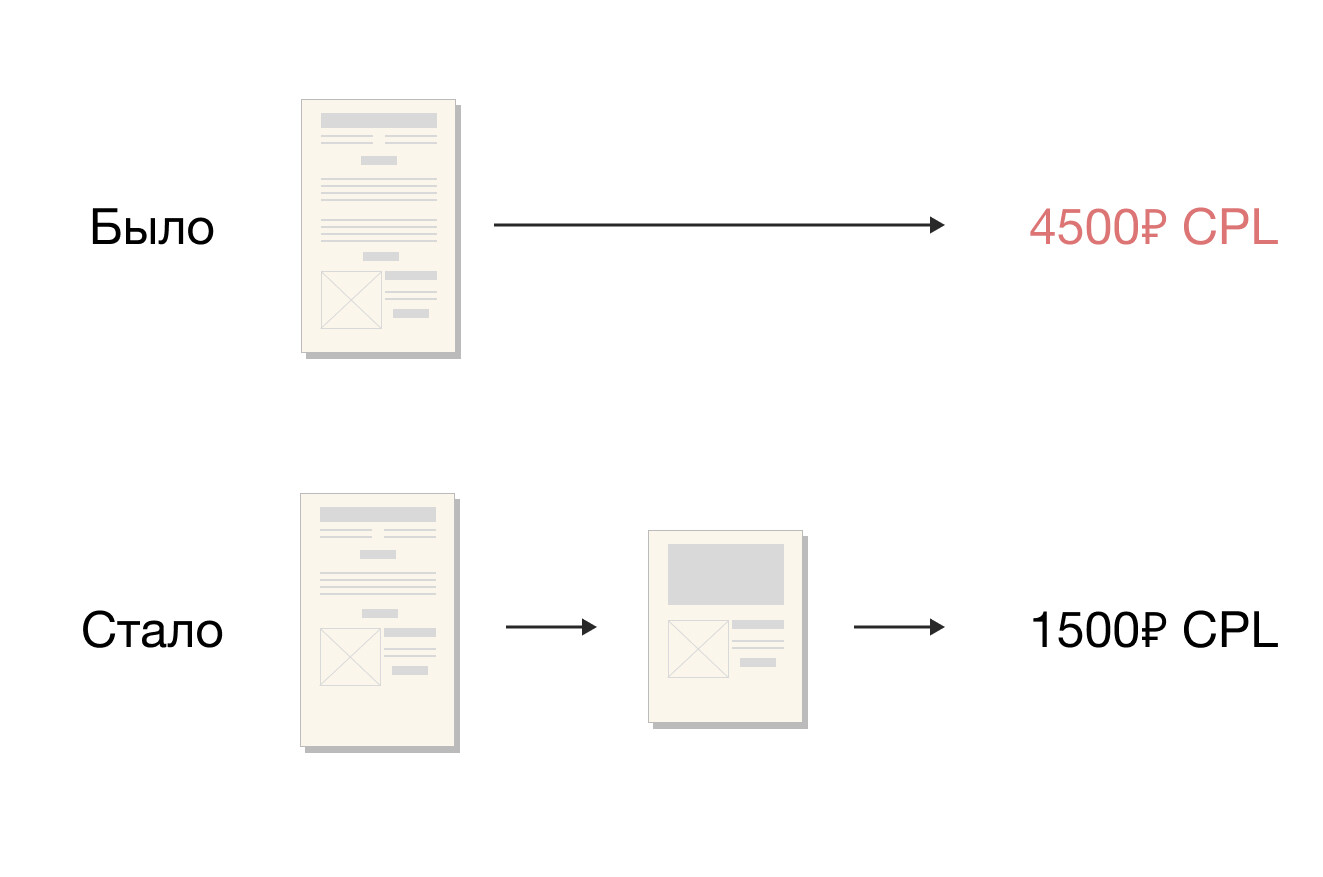
One successful iteration of such improvements was changing the user path when advertising a direct sale of the tripwire.
Initially the landing page looked like a regular lander: product information, benefits, prices, case studies, a “Buy” button.
Together with the client we improved the page:
— Removed the price information
— Changed the call to action to “Get the workshop”
— Created an additional “sales” page that users landed on after leaving a request on the lander. The page had a sales video from the expert and a One Time Offer with a 50% discount for buying right now.
These simple actions helped cut the cost per request 3 times and double the conversion to sale.
- We never stop
I think this is the most important point — never stop testing.
Every week we launch new creatives into tests, run A/B tests of landing pages and together with the client come up with new sales funnels. Only systematic testing makes it possible to deliver a stable result without dips and always have a plan B.
Client testimonial
Evgenia Andreyanova, marketing director at the consulting project
Egor and his team run Instagram ads for our project. And what can I say about the results? They are consistently good. They keep growing, volumes grow, the cost per lead goes down. Egor’s team gives us simply amazing results month after month. Besides that, I want to note the comfortable communication — for me, as head of marketing, it is very important to feel comfortable with a contractor, to be able to rely on them, not to supervise, not to micromanage every ad campaign. Watch the video testimonial