Indie film (US theatrical release): 2,405 ticket checkouts at $16.14, $38,869 budget
Updated:
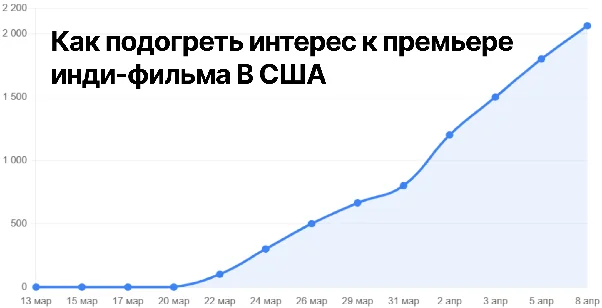
Situation and task
In March 2026 an indie film distributor came to us. The film was getting a limited release — not nationwide, but in specific theaters: Regal Union Square in Manhattan plus three venues in Los Angeles. Opening weekend — April 3–5, and those three days decided the fate of the run. Budget — $38,869.
The audience was clear: 18–38, fans of indie cinema and A24, people on Letterboxd, viewers of film essays on YouTube. What was unclear was how to measure the result.
Tickets were sold by Fandango, AMC and Regal — third-party platforms, with no access to their systems. Who actually bought a ticket after a click is impossible to see. The last thing we see is the moment a person on the film’s website clicks “Buy Ticket” and leaves for the theater’s site. So that is the event we optimize for: Initiate Checkout — the deepest one available. The whole campaign was built around getting people who actually buy to reach that button.
What we did
Three-phase funnel
Since optimizing for purchase was impossible, traffic quality had to be built into the campaign architecture.
Phase 1: audience building (March 13–20). Trailer and teaser ads on broad interests: indie cinema, festivals, the film’s actors. The goal — not sales, but pools for retargeting: who watched the video to 25/50/75%, visited the site, followed on Instagram. Zero checkouts in this phase — by design.
Phase 2: warm-up + NYC (March 20–29). Ahead of the New York opening on March 26, switched on retargeting to trailer viewers and a 1-mile micro-geo around the theater. Creatives with a push to buy: opening date, critic quotes, Q&A. Phase result — 664 checkouts at $8.11.
Phase 3: LA opening + NYC sustain (March 30 — April 8). Full launch in Los Angeles for opening weekend; in New York — only the warmest: visited the tickets page, watched the trailer to 75%+. Result — 1,398 checkouts at $12.86. CPA rose versus Phase 2 deliberately: in the narrow premiere window the priority is reach, not minimum cost.
Geo to match the city’s culture
At first, the same radius around all theaters seemed obvious. But cities move differently.
NYC — 1 mile around Regal Union Square. A walking city: a mile covers Union Square, Greenwich Village, East Village, Flatiron, NoHo.
LA — 5–7 miles around three venues. A car city, where 20–30 minutes behind the wheel is normal: Alamo Drafthouse DTLA, AMC Burbank, Los Feliz 3. The Alamo and Los Feliz zones overlap in Silver Lake and Echo Park — this is not a mistake: people see ads for both theaters, frequency doubles, conversion grows.
Micro-geo consistently beat city-wide targeting on CPA.
Budget ramped up toward the premiere
Core demand concentrates in the three opening days — that is where the maximum went. Phase 1 — minimum budget, Phase 2 — medium, Phase 3 — peak. After a successful start the client added $14,369, and 90% of that amount was spent in five days (March 31 — April 5) — opening weekend and the Q&A. Creatives were updated in real time: “Q&A Tonight with Cast”, “Live Q&A This Weekend”.
Google Demand Gen: failure and relaunch
Google Ads ran in parallel on smaller budgets. Demand Gen (YouTube + Gmail + Discover) was launched in Phase 2 as retargeting-only — and it was a complete failure: CPV shot up to $0.47 instead of $0.026, zero checkouts in three days. The pool turned out too narrow — the algorithm had nothing to learn from. Paused it; in Phase 3 relaunched on broad interest + keywords: CPA dropped from $51+ to $7–8, the level of Google Search.
Results
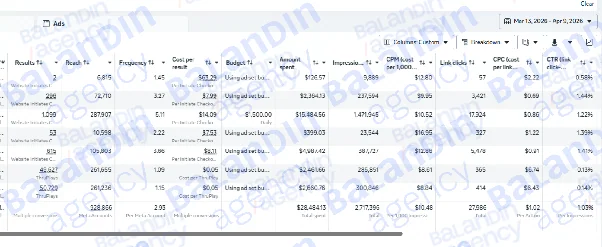
Campaign summary: 2,405 Initiate Checkouts on a $38,869 budget, blended CPA $16.14.
| Metric | Value |
|---|---|
| Budget | $38,869 |
| Initiate Checkout | 2,405 |
| Blended CPA | $16.14 |
| Video views | 1.97M+ |
Meta Ads — main channel:
| Metric | Value |
|---|---|
| Budget | $28,487 (73.4%) |
| Checkouts | 2,062 (85% of total) |
| CPA | $13.82 |
By phase:
| Phase | Checkouts | CPA |
|---|---|---|
| Phase 1 | 0 | — |
| Phase 2 | 664 | $8.11 |
| Phase 3 | 1,398 | $12.86 |
Insights
- Three-phase architecture. Phase 1 without a single checkout made Phase 3 efficient: without retargeting pools the premiere CPA would have been higher.
- Critic quotes sell better than the trailer. Proofs from The Hollywood Reporter, Variety, IndieWire consistently beat the trailer and poster on CTR and CPA — a third party is more convincing than self-presentation. The trailer, meanwhile, did its job building warm audiences.
- Geo radius = how the city moves. 1 mile in walking NYC versus 5–7 miles in car-bound LA.
- Launch Demand Gen in Phase 1, not mid-campaign. The algorithm needs time to accumulate signals: a start on March 13 instead of the 23rd — and all of Phase 3 would have worked from day one.
- Applicability. The three-phase structure transfers to any limited theatrical release; micro-geo — to any location-based product; press quotes — wherever authoritative media exist.