Ads paid back the spend 3x in one month for a kids soccer school in Brooklyn, New York
Updated:
The task
A kids’ soccer school in New York. The sale works like this: a parent submits a lead, an administrator calls and books the child for a trial lesson, and after the lesson the family buys a membership.
Ads ran on Meta lead forms and leads landed in the CRM. The ad account showed cost per lead, the CRM showed who came and who bought, but the two were not connected: a deal did not say which ad it came from. The only way to compare ads was cost per lead.
Three weeks after launch the school asked directly: how do we track the creatives that led to a sale, not to a lead? That became the task — judge ads by the cost of a completed trial lesson and of a sale.
What we did
- Launched lead forms so that every ad is counted separately. One campaign, one creative per ad set, about $30 a day. Otherwise the cost of a specific creative is visible neither in the ad account nor later in the CRM.
- Linked every lead to a CRM deal. We matched lead-form leads to deals by phone and email and wrote the source ad into the deal. The school’s working integration stayed untouched: ads were live, and breaking lead intake for the sake of analytics was not an option. From the school’s question to a working report — one day.
- Mapped the funnel to the school’s steps. Reached by phone → booked for a trial → came or missed → bought. We counted by the deal’s stage history, not its current stage: a closed deal does not say whether the child attended the lesson.
- Put the cost of a trial and a sale next to cost per lead. One report, per ad: spend, leads, calls reached, bookings, attendance, purchases and the cost of each step. The school got the same link.
- Ran new tests on the ads that already had payments. We tested interest targeting not on every creative, but on the ones that had brought families to a purchase.
Results
August 16 – September 16, 2026:
- Ad spend: $988
- Leads: 117 at $8.45
- Reached by phone: 59
- Booked for a trial: 44
- Attended a trial: 19 — $52 per completed lesson
- Bought a membership: 8 — $124 per sale
- ROMI: 304% — about $4,000 in revenue on $988 spend
Revenue is an estimate: one sale has its amount recorded in the CRM, the other seven are counted at the school’s typical deal size for the same period.
The key is the gap between ads. For the first weeks a static banner took most of the budget: it produced the most leads and looked like the winner in the ad account. On the day the end-to-end report went live the picture was: banner — $358, 46 leads, nobody attended a trial; first video — $147, 20 leads, three attended, one bought.
Totals per ad once the leads had matured:
| Ad | Spend | Leads | Cost per lead | Attended a trial | Cost per trial | Bought | Cost per sale |
|---|---|---|---|---|---|---|---|
| Static banner | $390 | 55 | $7.1 | 3 | $130 | 2 | $195 |
| First video | $213 | 28 | $7.6 | 8 | $27 | 4 | $53 |
| Second video | $157 | 17 | $9.2 | 4 | $39 | 2 | $78 |
| Other 8 ads (tests) | $228 | 17 | $13.4 | 4 | $57 | 0 | — |
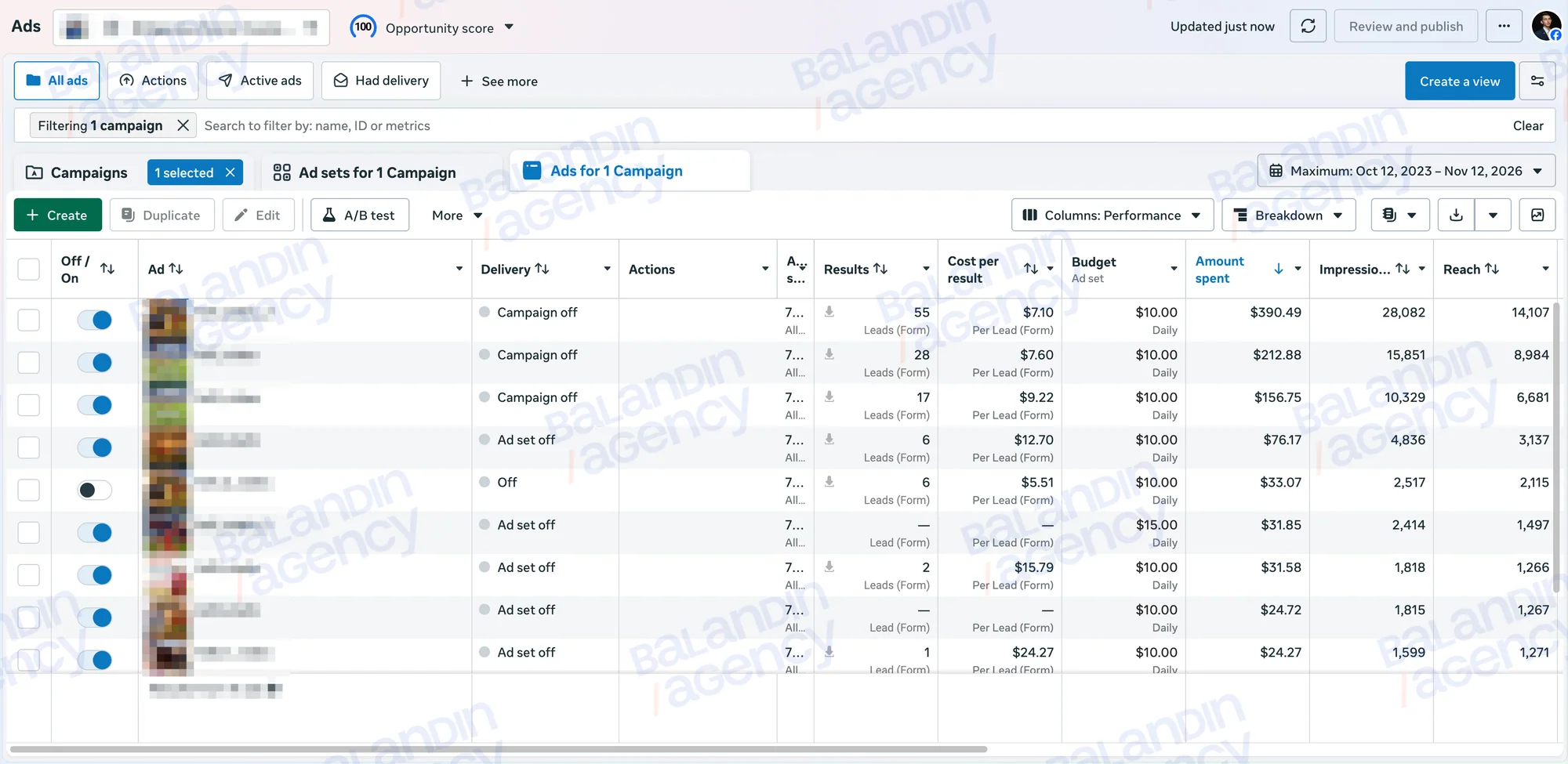
Cost per lead for the banner and the videos is almost the same, and the banner’s is even lower. A trial lesson from video cost $31 versus $130 — four times cheaper; a sale — $62 versus $195.
Insights
- Cost per lead did not separate ads whose cost per sale differed almost fourfold. $7.1 and $7.6 look identical in the ad account. Judged by cost per lead, the budget would have stayed on the banner: 55 leads versus 28. Judged by cost per trial lesson, the choice is the opposite.
- The loss was not at the lead or the call, but at attendance. The banner got 14 families booked for a trial — the same as the first video. 3 came versus 8. The banner attracted parents who agreed on the phone but never made it to the field.
- Sales trail the ads by weeks. The last membership from these leads was bought five weeks after the campaign stopped. A decision made in week one on cost per lead comes before the truth is known — so ads need to be measured at least down to the completed trial lesson.
- The end-to-end report took a day here, not a month. The school already had a CRM and an ad account; one link between them was missing. Without it, ads get optimized for people who submit leads, not for those who show up.