Business media for entrepreneurs: 45,000 subscribers for $36,700, budget scaled 3x without losing the KPI
Updated:
The task
An online magazine for people who work for themselves: freelancers, first-time entrepreneurs, small business owners. Content about money, clients, planning, motivation and health. The main platform was a VK community, with Instagram and a Telegram channel on the side.
Before us the magazine’s team ran ads in-house: a subscriber cost $0.59 in the best campaign and $0.80+ on average against a $0.46 target. Narrow audiences (designer communities, online schools) burned out in days, so there was nothing to scale.
The task for autumn 2022: tens of thousands of subscribers in a quarter on a budget of up to $13,500 a month — and hold the cost per subscriber while the budget grows several times over and the pre-New-Year auction gets more expensive.
What we did
Split the budget into production and test. Each hypothesis got enough for 50 conversions (about $33). Inside the KPI → moved to production; outside → switched off. 10–20 hypotheses went through this every month, each as its own row in the reporting sheet with spend and cost per subscriber. The client saw what they paid for, and the production budget never went on experiments.
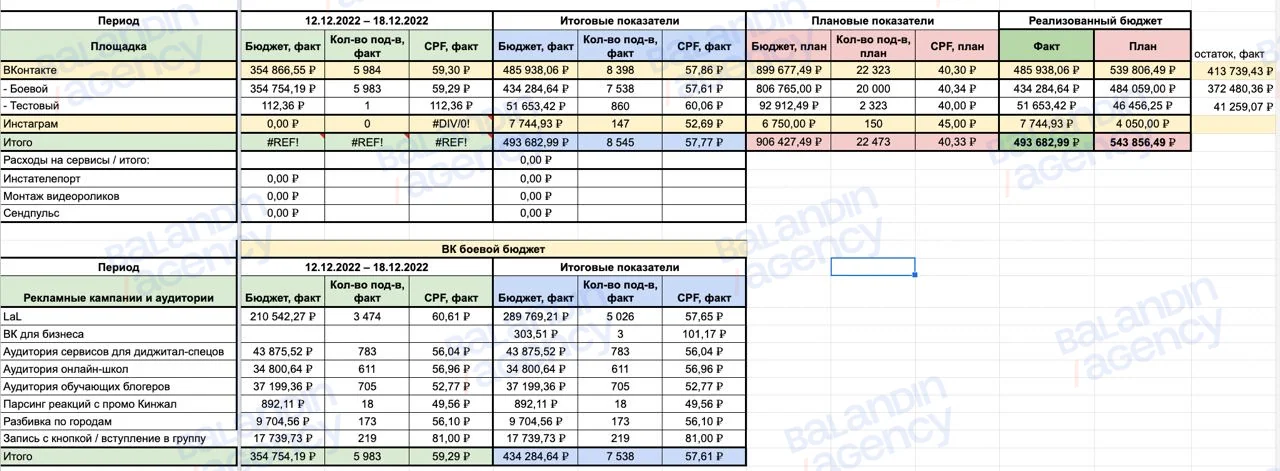
Found a scalable setup in the first two weeks. Lookalike audiences built from reactions to competitors’ promo posts and from the magazine’s own base. By 11 October: 1,050 subscribers at $0.47, inside the KPI. In October the lookalike brought 5,494 subscribers at $0.54 and took $2,985 of the $4,011 VK budget: one setup carried the whole plan.
Rebuilt the audience instead of swapping creatives. When the lookalike started to burn out, we rebuilt it from the reactions accumulated since — the base grew with the ads, and each rebuild was more precise than the last. That is how one production creative — a plain “who we are” introduction — ran for the whole project, beating memes, video, reposts from the community and pain-point creatives. Its CTR was twice the account average.
Scaled the budget 3x in two months. October — $4,900, November — $10,400, December — $13,400. At the peak of the New Year auction we ran up to $830 a day on a single community, 1,000–1,700 joins a day.
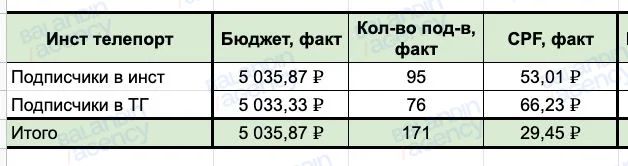
Instagram → Telegram in one campaign. Ads led to a “Top 12 articles for freelancers” bundle; the Instateleport service checked the profile follow and delivered the bundle in the Telegram channel. One campaign fed two platforms: in October, 650 subscribers at $0.59 on Instagram and 246 at $0.57 on Telegram.
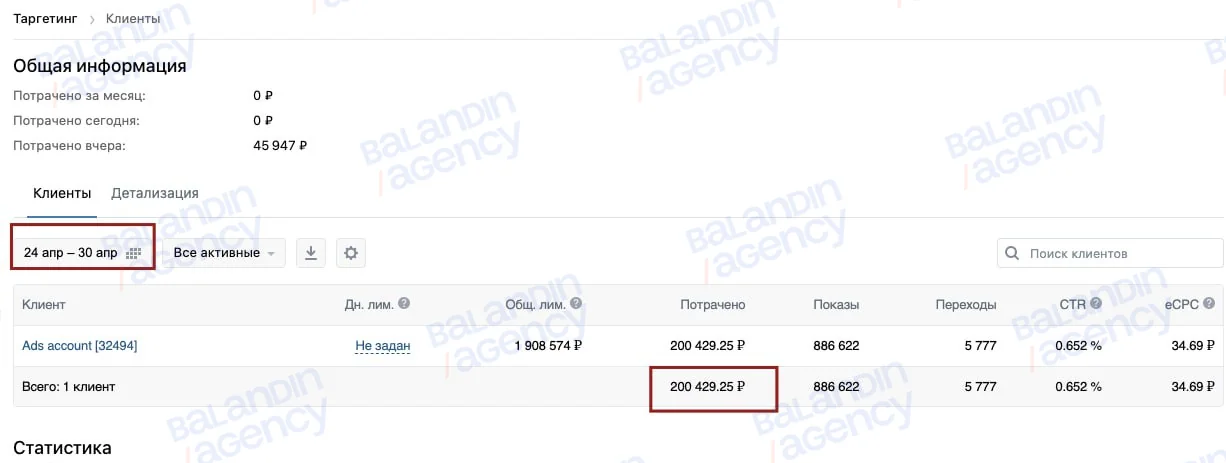
Proved to the client the result was bigger than the ad account showed. We matched joins reported by the VK ad account against the community’s actual daily growth: the account consistently missed ~30% of subscribers who came from ads. The delta was the same day after day — organic growth does not behave like that. The client factored it into the KPI.
Relaunched the project for a new audience. In spring 2023 the magazine shifted its focus to entrepreneurs — a smaller audience with more competition for it. We rebuilt the hypotheses for the new ICP (small-business support communities, communities of the magazine’s own readers, competitors), found a working setup in three weeks and landed at $0.47 per subscriber against a $0.46 target. In parallel we trained the new VK Ads account ahead of the forced migration.
Results
Eight months of work (October 2022 — May 2023, paused in January–February):
- Ad spend: $36,711
- 45,048 subscribers by ad account data
- $0.68 per subscriber against the client’s target of $0.50–0.80 depending on platform
By platform over the first two months: VK — $12,368 → 19,358 subscribers at $0.64; Instagram — $2,267 → 2,769 at $0.82; Telegram — $634 → 754 at $0.84.
The community’s actual growth was higher than the ad account numbers. For 1–18 December the account reported 8,445 joins while the community grew by 12,310: in fact a subscriber cost $0.60, not the $0.87 the account showed — inside the KPI even at the peak of the New Year auction.
Cost per subscriber is calculated on $30,791 — the spend with documented subscribers. For 19–31 December only the spend survived ($5,920); those subscribers are not in the total, so the real cost is lower.

Insights
Lookalike audiences live in cycles — and that is manageable. A lookalike built from reactions holds the KPI for 2–3 weeks, then burns out. The fix is not new creatives but rebuilding the audience from the reactions that piled up since. One setup carried the whole project this way.
The VK ad account undercounts a third of ad-driven subscribers. A join is attributed only within ~10 minutes of the click. Someone who opened the community, read for a while and joined an hour later counts as “organic”. Measure by community growth, or the agency looks worse than it works.
A test budget separate from production is the main trust tool. The client sees every hypothesis with its cost and its verdict. In eight months there was not a single argument about where the money went.
One introduction creative beats pain-point creatives. For media with a broad audience, a “who we are and what we write about” text consistently outperformed segmented angles, memes and video. The only segmentation worth doing was by age: 21–30 respond to “just started in business”, 31–40 to the same text without the word “beginner”.