Private event advertising for an Italian restaurant in New York City (USA): $2M in revenue over two years, ROMI 1907%
How a restaurant in Midtown Manhattan, where private events only happened when someone called by chance, got a dedicated flow of event leads from Meta Ads
Updated:
The task
A well-known Italian restaurant in Midtown Manhattan. A beautiful room, a strong kitchen, a full house in the evenings. Private events, though, happened on their own: someone called, someone walked in and asked.
What hurt:
- Nobody was selling the most profitable product. A private event is the highest-margin night a restaurant can have: one full buyout earns more than three regular services. Yet there was no event marketing at all.
- Nobody knew the restaurant as a venue. People did not search for it for a corporate dinner or a wedding reception, because nobody had ever told them it could host one.
- The only advertising was the Boost button on Instagram. Posts were promoted straight from the app. That brought no leads, and there was nothing to measure.
The task was to build a flow of private event leads from scratch and to measure the result in booked events, not in the number of contacts.
What we did
We built the funnel together with a new events team on the restaurant’s side. The split is simple: advertising brings the lead, the restaurant’s managers turn it into a booking. One does not work without the other.
- Two segments, two strategies. We targeted corporate planners by job title, industry and behavior — they account for 65% of bookings. Private celebrations — birthdays, weddings, baby showers, anniversaries — were targeted by life events and intent signals, which is the other 35%. A corporate planner and a bride choose a venue differently, and one campaign cannot reach both.
- Creative testing inside each segment. We compared three kinds of shots: table setups, the room interior, the food. Corporate planners respond to the room, private hosts respond to the set table. We learned that by testing; it could not have been guessed in advance.
- No native lead forms. A form inside Facebook produces many contacts and little value: a person leaves a phone number in one tap and an hour later does not remember doing it. We sent traffic to a dedicated events page on the website and optimized campaigns for leads submitted there. There were fewer leads, but the managers stopped calling people who did not remember clicking.
- Server-side conversion tracking through Stape. After the iOS restrictions the pixel sees only part of the leads. Server-side tracking gave the campaigns complete data again, so the algorithm learned from real leads rather than fragments.
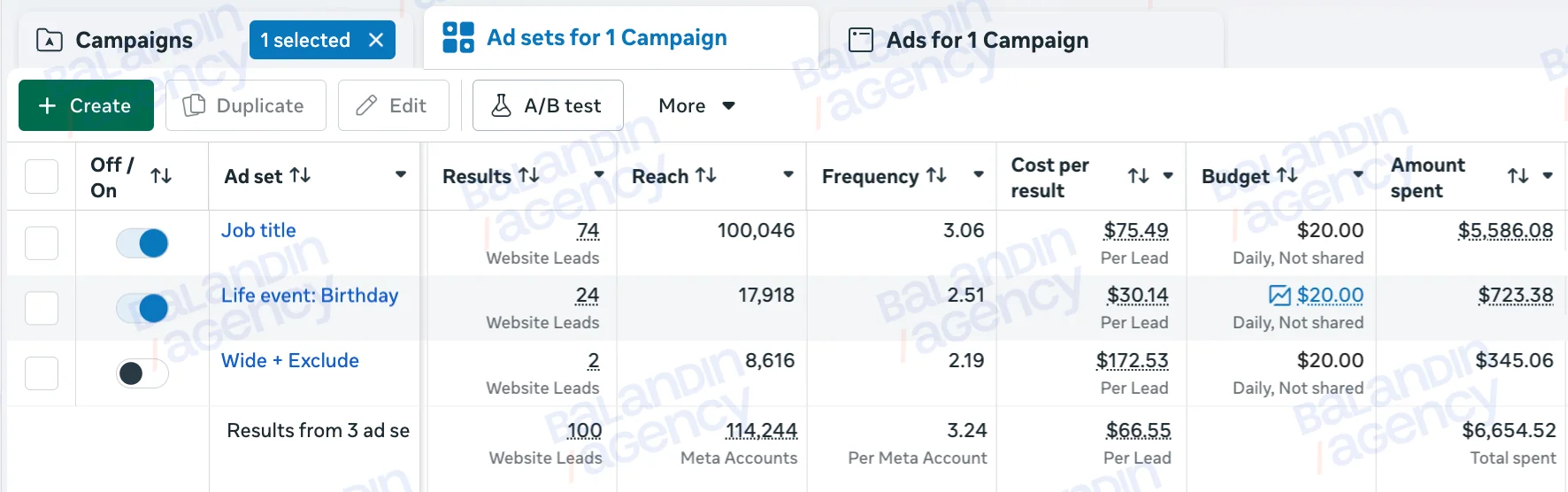
A slice of one campaign in the Meta ad account. A lead from a corporate planner costs two and a half times more than a birthday lead — $75 against $30. The broad audience with no segment was switched off: two leads at $172.
Results
Over two years of work:
- Ad budget — about $100,000.
- Event leads per month — from about 60 to more than 200.
- Booked events — almost doubled year over year.
- Private event revenue in year one — $827,000.
- Private event revenue in year two — $1,180,000, up 43%.
- ROMI — about 1,900%: every dollar of budget brought about $20 in private event revenue.
Before the launch there was no lead flow at all, so there was nothing to compare with. Year three is running ahead of year two.
Insights
- An expensive lead can be the most profitable one. A corporate lead costs $75, a birthday lead costs $30. Judging by cost per lead alone, the corporate segment looks like one to switch off. Yet it is the segment that brings 65% of bookings.
- Lead quality matters more than volume. Anyone can fill a spreadsheet with lead-form contacts. Only a booked event counts, and it is worth getting fewer leads for it.
- Advertising and sales are one system. Growing from 60 to 200+ leads a month only makes sense when a person answers each lead quickly. That is why the funnel launched together with the events team.
- Private events are a separate business inside a restaurant. They have their own buyer, their own decision cycle and their own advertising. As long as they are promoted alongside dinners, they do not grow.