Private event advertising for an Italian restaurant in Brooklyn (USA): 362 leads, $120,000 in sales, ROMI 410%
How a restaurant in Downtown Brooklyn stopped boosting posts and started selling itself as a venue for weddings, birthdays and baby showers through Meta Ads
Updated:
The task
An Italian restaurant in Downtown Brooklyn with a good location and a warm room. It hosted private events, but they came only through referrals.
What hurt:
- Advertising came down to boosting posts. Like many restaurants, this one saved on advertising and limited itself to the Boost button on social media. That brought no leads.
- The room stood empty in slow periods. An analysis of the point-of-sale data showed the average check, the popular and unpopular menu items, and the weak seasons, days and hours. Regular dinners did not fill those gaps.
- Events were underused. The venue suited weddings and family celebrations, but the website did not even have a page where someone could leave an inquiry.
Together with the general manager we changed the focus: promote the restaurant not as a place for dinner but as a venue for events. A banquet is a high-ticket product with a long decision cycle: the venue is chosen weeks and months before the event, comparing several options. One event here is worth $8,000–12,000. So the channel has to be judged not by cost per click but by final sales.
What we did
- Started with the point-of-sale system, not the ad account. First we looked at sales: what is bought and when, and where the gaps are. The decision about events came from there — from the restaurant’s own numbers, not from advertising fashion.
- Built an events page with a form. A dedicated page on the website with one purpose: a person leaves an inquiry with a date and a number of guests. All advertising led to it.
- Split the occasions into separate campaigns. A restaurant usually runs one “host your event with us” campaign — a message for everyone that hooks no one. We made three: weddings, birthdays, baby showers. Each has its own audience, budget and optimization.
- Matched the creative to each occasion. The table setting a bride wants to see will not sell a birthday dinner. Each segment was shown its own celebration.
- Connected the Conversions API from day one. Leads from the website form were passed to Meta through Zapier. The algorithm received complete data on leads, and we could assess their quality.
- Measured the channel through to sales. For eleven months, from September 1, 2022 to July 2023, the result was judged by banquet sales, not only by cost per lead.
The ad budget was about $5,000 a month.
Results
Over 11 months, September 2022 — July 2023:
- Ad budget — $23,536.
- Leads — 362.
- Cost per lead — $65.02.
- Banquet sales — $120,000.
- ROMI — 410%.
The three occasion campaigns kept running after that. Over their whole lifetime in the Meta ad account:
- Weddings — 224 leads at $56.48, spend $12,650.88.
- Baby showers — 162 leads at $57.83, spend $9,369.17.
- Birthdays — 256 leads at $62.17, spend $15,916.69.
- Total — 642 leads at $59.09, spend $37,936.74.
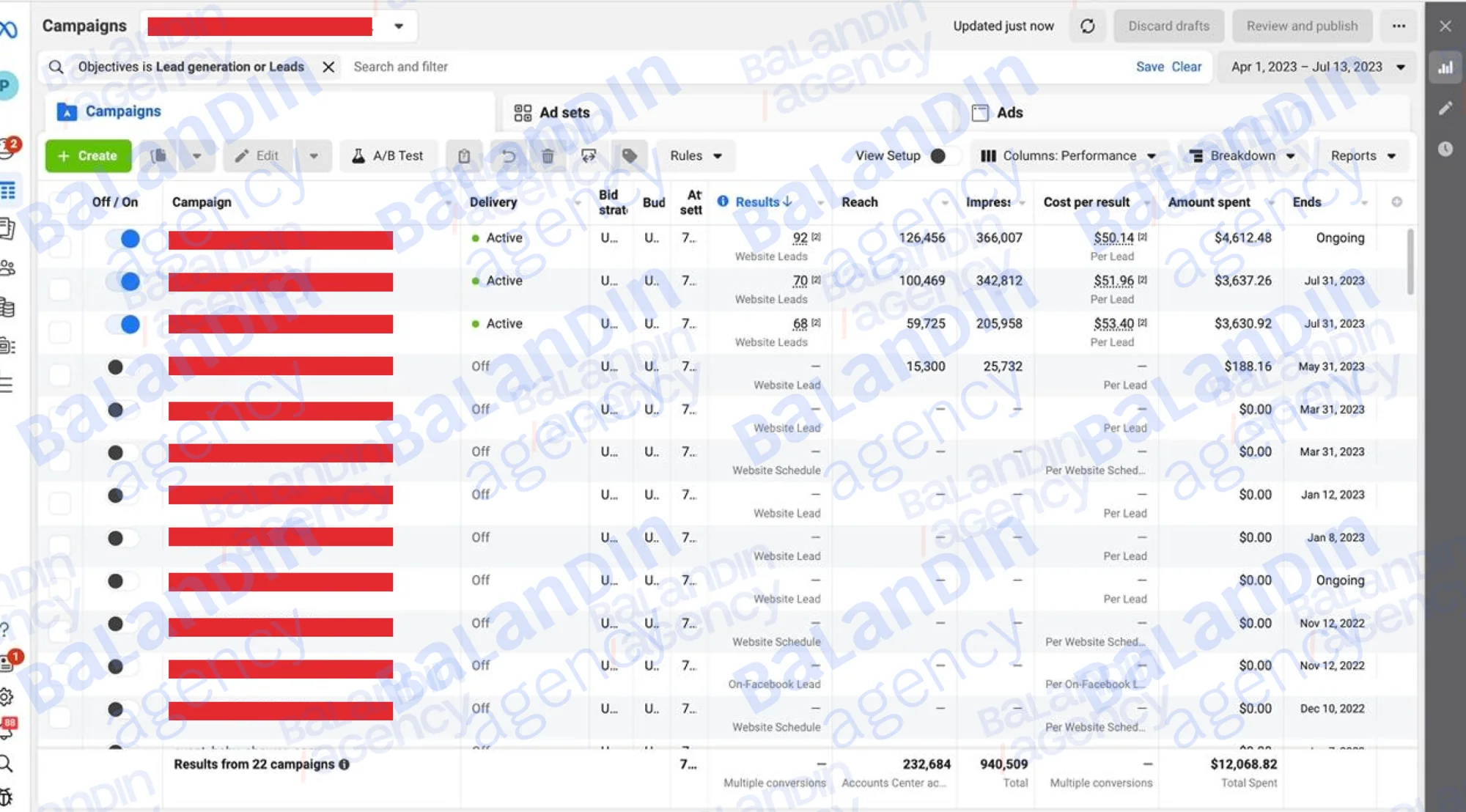
A slice of the account for April — July 2023: three active campaigns, 230 leads at $50–53, spend $12,068.82.

The same three campaigns over their whole lifetime: one row per occasion. The right-hand columns explain why weddings pay off best: the click there is the most expensive — $2.63 against $1.50 for the others — while the lead is the cheapest.
Insights
- An expensive lead is paid back by the ticket. A $65 CPL sounds expensive until you look at the economics: on average one lead brought about $331 in sales, and total sales exceeded the ad budget 5.1 times. The banquet line allows paying tens of dollars per lead and staying deep in the black — where low-ticket “table booking” ads do not add up.
- The most expensive click gave the cheapest lead. A wedding click cost $2.63, a birthday click cost $1.50. But the wedding audience submitted an inquiry almost twice as often: 4.7% of clicks against 2.4%. As a result the wedding lead came out cheapest of all. One general campaign would not have shown this.
- Segmentation is respect for how people choose. A bride, the parents of a birthday child and a mother-to-be have different budgets, timelines and worries. A separate campaign lets you talk to each about their own event.
- An advertising decision starts with the restaurant’s data. The shift to events came out of the point-of-sale analysis: advertising reinforced what the business actually needed.