Launching an IT job search service: 2,134 sign-ups at $1.58, 672 resumes, $3,381 budget
Updated:
$3,381
Ad spend
2,134
Sign-ups
The situation and the task
A job search service for English-speaking IT specialists was entering the market. The product works like Tinder: an employer cannot message a developer until there is a mutual match. Before launch the base had to be filled with candidates and the economics understood: what does it cost to bring in one middle+ developer.
The client expected a sign-up at about $5.40 (5 €), and that figure became the target. The audience is expensive: middle+ developers, English-speaking, fought over by recruiting platforms and employers themselves.
What we did
- Cut the wrong people before launch. Worked through the user portrait and defined who was definitely not needed: juniors, non-English speakers, non-developers. The budget did not go to sign-ups that would never bring the service money.
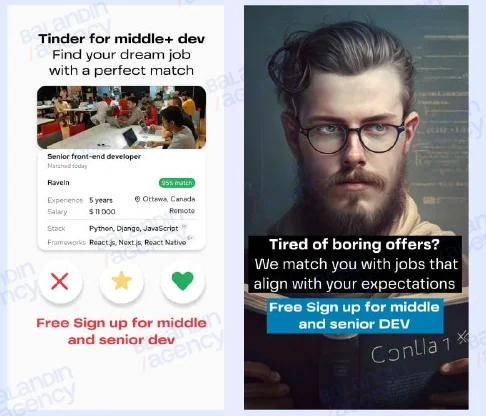
- Put the product’s “trick” into the creatives. The mutual-match mechanic, without which an employer cannot reach a candidate, became the main message. For a developer tired of recruiter spam it is a clear benefit. This angle cut the cost per sign-up several times over.
- Set up analytics across the whole funnel. Every step (sign-up → completed profile → posted resume) was tracked in Google Analytics for analysis and in Facebook for optimization. Optimizing for deep events gave cheaper resume postings than optimizing for sign-ups.
- Generated visuals with neural networks. Triggering banners for the developer persona were made with AI rather than by a designer by hand. The best ones drove the main flow of sign-ups.
Results
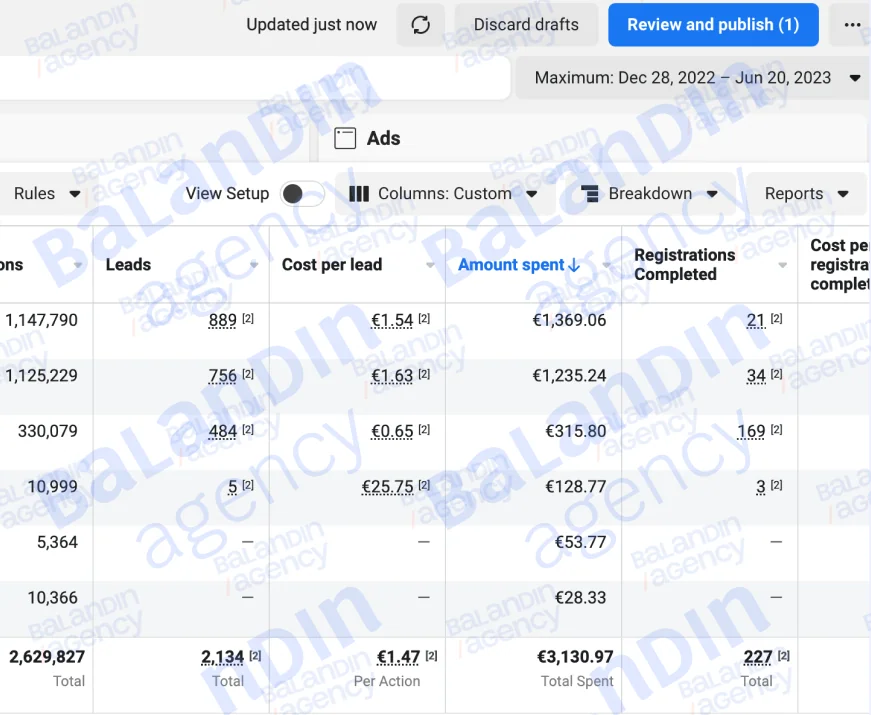
- Ad budget — $3,381 (€3,130.97)
- Sign-ups — 2,134 at $1.58 (€1.47)
- Completed profiles — 1,407 at $2.40
- Posted resumes — 672 at $5.03
The candidate base grew so fast that there were not enough employers. The next stage was bringing in the companies looking for developers.
Insights
- A sign-up at $1.58 on a middle+ developer audience against a $5.40 plan: the launch economics came out more than three times better than expected. The client’s real reference point is not the sign-up but the posted resume at $5.03.
- The “who we do not need” portrait saves more budget than the “who we need” one: every excluded non-target segment is sign-ups we did not pay for.
- The main message is the product mechanic, not “find a job”. The match approach solves a specific developer pain (recruiter spam), and it reads straight off the banner.
- Optimizing for a deep funnel event beats optimizing for sign-ups on the cost of the final result. Without full analytics you cannot see it.