Appliance repair academy (USA): zero sales in month one, 160 leads at $19 and 222% ROMI by month two
Updated:
The task
A US online academy trains home appliance repair technicians. Ad leads go straight to the sales team, which closes them on the course. Name not disclosed (NDA).
We were brought in not to replace the existing agency but alongside it. The client already had winning creatives and combinations that worked. Copying them made no sense: the client was already paying for exactly that. Our task was to rethink the ad format so it kept working, and to give the academy a second independent source of leads.
That immediately raised the question of how to judge the second agency. The usual approach is to switch one off, bring in another, compare. Here both run at the same time, and the second agency’s first month is a search, not scaling something proven.
What we did
- Month one — searching for a format, not copying combinations. One lead campaign, each hypothesis in its own ad set with a single creative so the cost per lead was visible for each. 14 ad sets ran in May: statics, carousels, a first video. The best static brought leads at $11–15, the worst at $43–75, the monthly average was $19.6. Leads came in, sales did not.
- Finding out why they did not buy. We looked at who was submitting leads, at competitors’ ads and at the sales team’s rejection reasons. Two things came up: part of the leads were people looking for a job, not for training; those who wanted to study did not see the value — why this academy and why it was worth the money.
- Changed the message. Instead of “become a technician, earn money” we spelled out the audience’s problems: the specific difficulties a person faces before deciding to change profession, and how the training solves them. That filters out job seekers and raises the value of the offer for people ready to pay.
- Moved to video. From mid-June the new messaging ran as video: the first videos of the new wave brought leads at $15–16, then five more videos went in with 2–3 kept in rotation. From the second half of June no statics were running in the account.
- No panic over zero sales. Neither we nor the client stopped the ads after the first month — we went straight into the next iteration on the same budget.
Results
May 4 – July 22, 2026:
- Spend: $3,070
- Leads to the sales team: 160
- Cost per lead: $19.1
- Sales: 6 — none before, now almost every day
- ROMI: 222% — about $9,900 in revenue on $3,070 spend
The first month on its own: $1,211, 63 leads at $19.2, zero sales. The cost per lead barely changed between the months — what changed was who the leads were: they started converting into purchases.
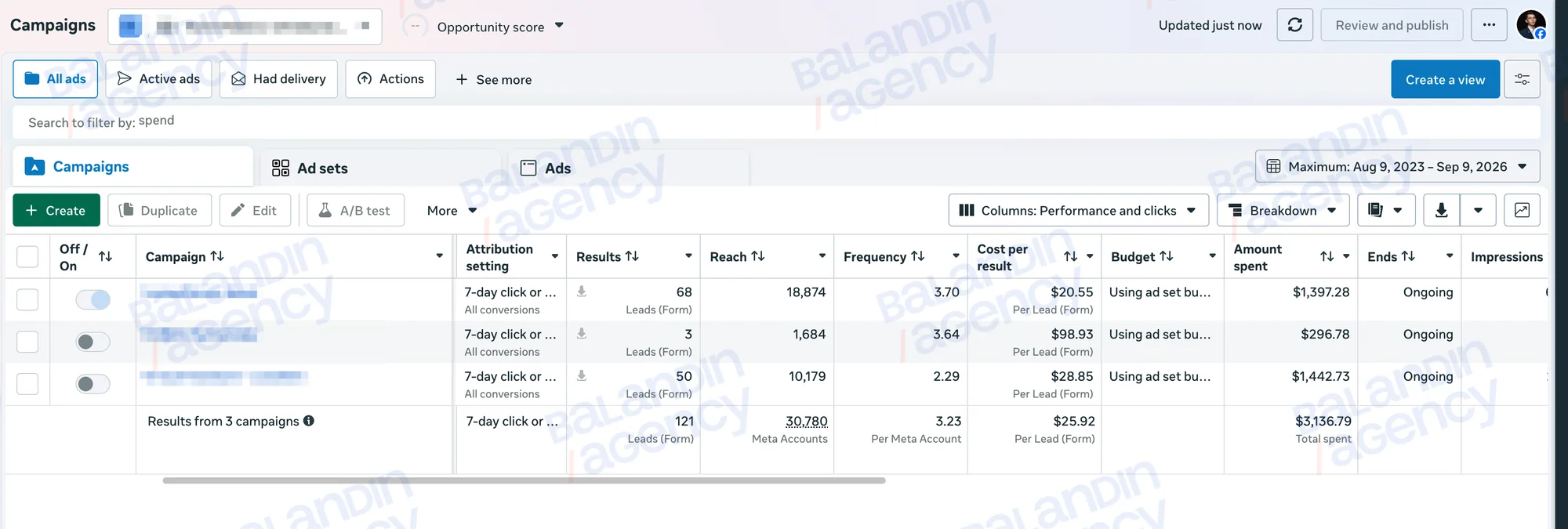
Ads ran in three of the client’s ad accounts one after another: the first in May–June ($1,397, 68 leads at $20.55), the second from mid-June, a third in parallel in July. Ads kept running until mid-August: in total from May to August 19 — $5,315 and 230 leads at $23.1.
Insights
- A first month with no result is a search, not wasted money. When ads pay off in the first month, you usually just entered a segment you had not been in before, with little competition. Making a niche pay off in 30 days when it has never bought through you is nearly impossible. Stopping after a fruitless first month means losing the second: the combinations that later pay off are found in the first.
- Cost per lead said nothing about sales. $19.6 in month one and $19.1 in month two — the same price, with 0 and 6 sales. A cheap lead from a job seeker costs the same as a lead from a future student. Look at who the leads are, not at CPL.
- A second agency is judged by what is new, not by repetition. Copying someone else’s working combinations is a quick way to show “the same result” and bring the client nothing new. The value of a second team is an independent lead source with a different message.