Interior design online school: $12,971 in Meta in 2025 → 5,952 registrations at $1.55, 204% ROMI
Updated:
The task
A practicing interior designer with 15 years of experience in Russia and Europe sells professional training: a flagship course at around 70,000 ₽, paid webinars, mini-courses and marathons on GetCourse. The audience is Russian-speaking women outside Russia: those considering a career change, on maternity leave, or renovating their own home and wanting to handle the design themselves.
Meta ads had been running since late 2023. By the end of 2025 the client had the question that kills any webinar funnel: registrations are there, but is there money behind them? The ad account shows registrations, GetCourse shows payments, and nothing connects the two. The client’s team counted it their way: over 28 months, 15 people from abroad joined the flagship course. By that logic, the ads did not pay off.
The task: keep registrations flowing into launches and the automated funnel, and show that ads bring payments, not just registrations.
What we did
Two traffic loops. The main one: webinar and automated-webinar registrations through the website — “Design ABC”, live launch webinars, a free lead magnet, the “kitchen-living room” funnel. The second: traffic to the Instagram profile and reels, because part of the audience does not buy from the first webinar but after months of warming up in the profile. In 2025, $9,207 went to registration funnels and around 137,000 ₽ to profile traffic.
Reels instead of ads. The best performers were videos that did not look like ads: a reel from the expert’s account, promoted as is. One such reel brought a checkout click at around 1,000 ₽. Static creatives performed worse and were reworked.
Segments instead of one offer. The audience was split into four segments by motivation taken from the client’s site: mothers on maternity leave, career change, renovating their own apartment. Each got its own video voiced by the expert and a separate ad set at $10 a day: that shows faster which angle works, and the winners got two more videos each.
Reconciliation down to payments. When the payback question came up, we exported every registration and every payment for 2025 from GetCourse and matched them by e-mail to ad UTM tags. We counted by first touch: if a person learned about the expert from an ad, registered, warmed up for six months and bought from another event, they are ours. That produced the first ever table of “customers from ads” with payment amounts per person.
Results
In Meta in 2025: $12,971 spend (1,145,101 ₽), of which $9,207 on registration funnels → 5,952 registrations at 123 ₽ ($1.55). Registration campaigns reached 2.46M people, CTR 0.93%, 22,959 clicks at 32 ₽, click-to-registration 26%.
Profile traffic on the same budget brought visits at 2–3.5 ₽: in November 2025, 2,497 visits at 2.34 ₽ in one week.
GetCourse reconciliation for 2025: 71 buyers with ad tags (16 with UTM facebook, 55 with UTM instagram), purchases from 3,990 ₽ for a mini-product to 219,000 ₽ for the flagship. Buyer geography: Cyprus, Georgia, Netherlands, Austria, New Zealand, USA, Belarus, Kazakhstan, Spain. After the recount, return on ad spend is 204%.
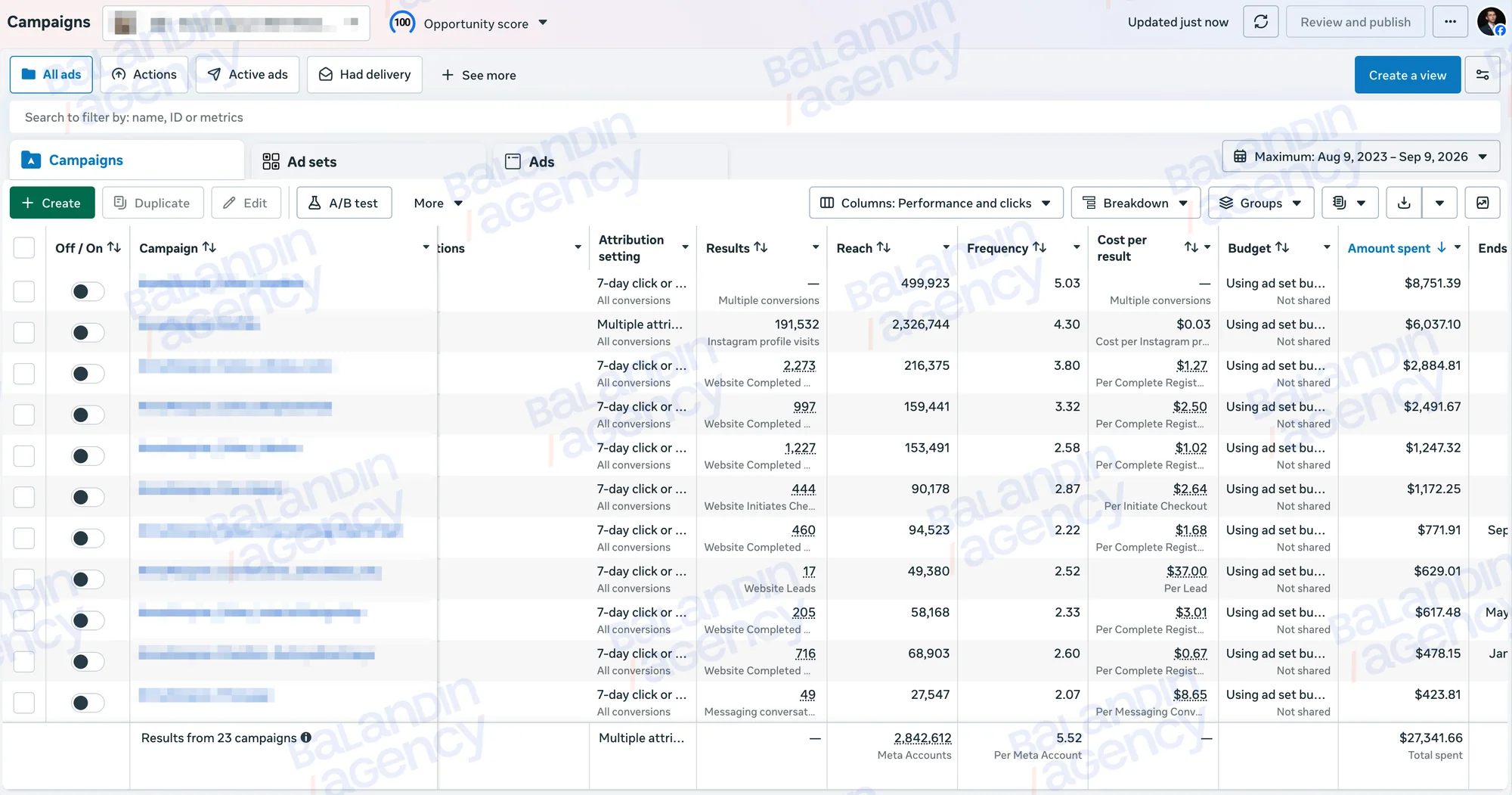
Since December 2023 the ad account shows $27,342 spend and 2.84M reach across 23 campaigns.
Insights
The ad account cannot see payments that arrive six months later. In GetCourse, payments carried event tags, not ad tags, and at first glance the ads did not pay off. Once registrations and payments were matched by e-mail and counted by first touch, “15 students in 28 months” turned into 71 buyers in a year.
In this niche the Instagram profile is not a brand expense but a second funnel. Of 71 buyers, 55 came with instagram tags: they entered the profile from an ad, watched content for months and bought later through the organic link in the bio.
A cheap impression is not a cheap customer. The algorithm pulled impressions into low-CPM countries where the course costs two or three monthly salaries. Expensive products were bought from Europe, the USA and New Zealand, so geo has to be cut by purchasing power, not by registration cost.