Online psychology school (Meta Ads): $107,537 → 48,008 registrations at $2.24, 107% ROMI
Updated:
The task
An online psychology school built around one founder-expert. The product is paid courses; the entry point is a free online training on a specific pain: apathy, panic attacks, anxiety, psychosomatics. Name not disclosed (NDA).
The task since July 2024 has been a steady flow of registrations for the free trainings at a price where course sales pay back the ads. Not a one-off launch but a monthly volume: the school runs several trainings and each one needs traffic.
What we did
- A separate funnel for every pain. Not one generic “psychology course” but a campaign per specific request: apathy, panic attacks, anxiety, depression, psychosomatics, a sense of meaninglessness, relationships, marriage, communication, “life after 40” for women, “after 55”. Over two years — 21 funnels. A person in the feed recognizes their own pain, not abstract “psychology”, so the registration is cheaper.
- Series format versus a single training. The same topic (“panic attacks”) ran in two formats: a single lecture and a series. Both lived side by side for more than six months, with budget split between them by cost per registration.
- Rotating leaders. In the first year the budget sat on the “apathy” funnel ($21,696) and two panic-attack funnels ($22,257 combined). From July 2025 “psychosomatics” became the main one — $34,066, more than any other. Weak topics (IBS, meaninglessness, “mom”) were closed after a $300–900 test.
- Format and bid tests. November 2025: three VSL variants and bid cap on the three best topics. Bid cap on “apathy” delivered registrations; on “anxiety” it delivered zero for $1 and was switched off the day it launched.
- Purchase retargeting and Telegram channel growth. Separately we tested retargeting to a course purchase (August 2024) and drove subscribers to the expert’s Telegram channel for six months (January–June 2025, $5,453).
- Scale without bloating the structure. 31 campaigns and 1,047 ads over two years. Budget moved between funnels by cost per registration instead of spawning campaigns.
Results
July 2024 – August 2026:
- Spend: $107,537
- Registrations for free trainings: 48,008
- Cost per registration: $2.24
- ROMI: 107% — $222,602 revenue on $107,537 spend
- Account: 21 funnels, 31 campaigns, 1,047 ads, 15.9M impressions
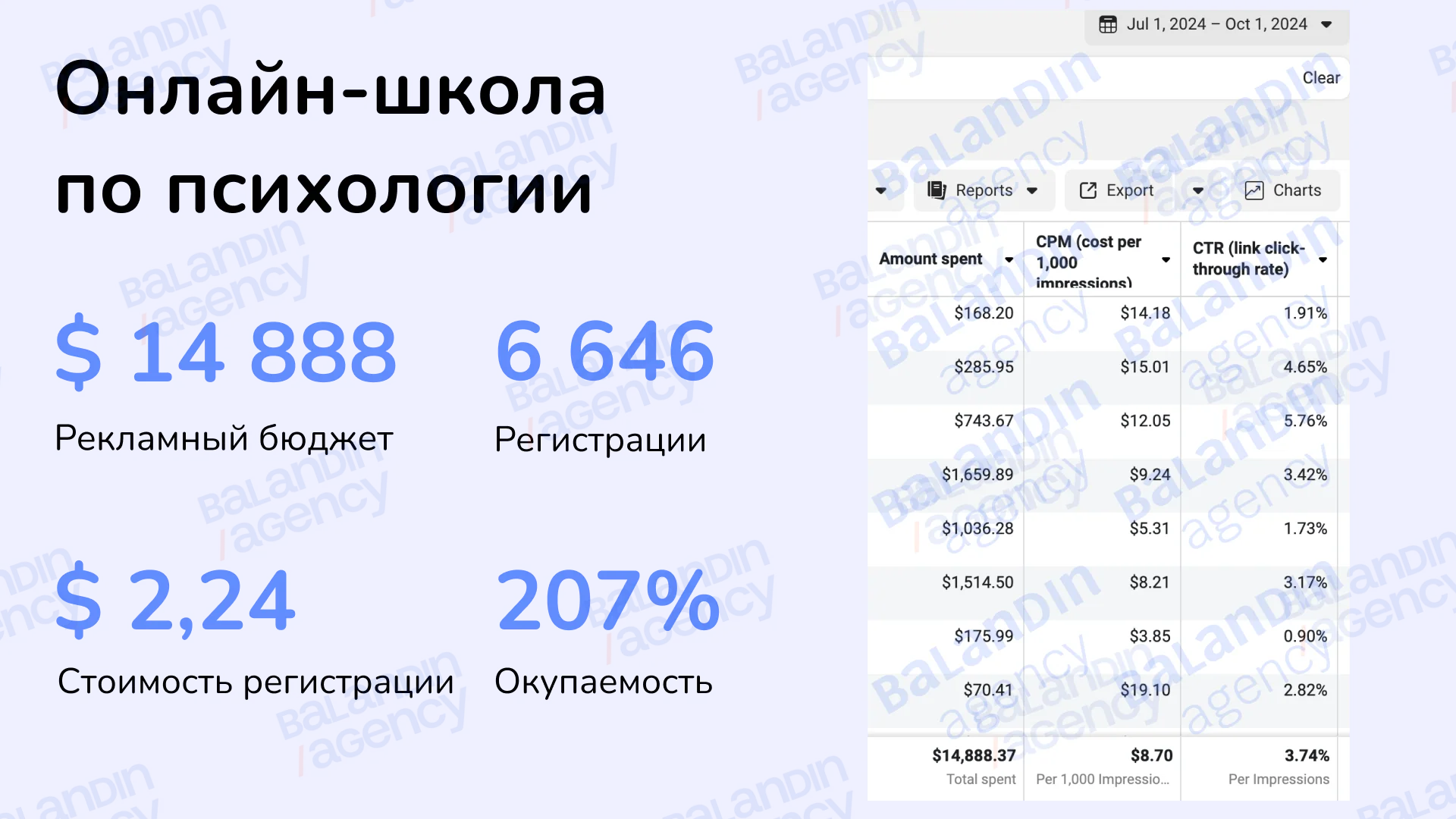
Cost per registration and ROMI are taken from the verified period July 1 – October 1, 2024: $14,888 spend, 6,646 registrations at $2.24, CPM $8.70, CTR 3.74%.
Spend by leading funnel over the whole period:
| Funnel | Period | Spend |
|---|---|---|
| Psychosomatics | 07.2025 – now | $34,066 |
| Apathy | 07.2024 – 11.2025 | $21,696 |
| Panic attacks (lecture) | 08.2024 – 10.2025 | $11,488 |
| Panic attacks (series) | 07.2024 – 06.2025 | $10,769 |
| Expert’s Telegram channel | 01.2025 – 06.2025 | $5,453 |
The partnership continues: in September 2026 the main budget is on the “psychosomatics” funnel.
Insights
- A pain in the headline sells better than a topic. “Panic attacks” and “apathy” are specific states people search for and recognize in the feed. “Psychology” and “self-development” are not. Of 21 funnels, five live long — and all five are about a specific symptom.
- The leader changes — the budget follows. The “apathy” funnel led for a year, then gave way to “psychosomatics”. Keeping budget on a burnt-out topic costs more than launching a new one each quarter.
- A topic test costs $300–900. That is enough to see whether registrations come in at the target price. Weak topics were closed at that budget instead of waiting for them to “pick up”.
- An expensive registration ≠ a bad topic. “After 55” brought registrations at $2.17, “relationships” at $10.63. What decides is course sales after the training, not the registration price — so a topic was never closed on registration cost alone.